- Tomatoes
- Olive oil
- Salt
- Herbes de Provence
Thursday, April 5, 2018
Recipe: Confit of Tomatoes
I'm baaaaaack!
And, well, now I don't "work" because three kids kind of take up some of my time.
But the thing is, I still volunteer in the community, I still find time to cook, and I still hang out with my friends... without kids (shocking, I know). I just do things much differently than I was doing things eight years ago. I don't take bad food photos with my BlackBerry Pearl, for one thing. I now take bad food photos with my iPhone. And my elaborate week-night meals of handmade pasta or the casual lemon meringue pie are no longer. I'm super good about putting a yummy meal on the table with whatever I remember I have in the fridge or whatever my CSA box contained that week.
So, as I re-launch AmniEats, I start simple, with a confit of tomatoes. It's a super easy side dish that brings to the forefront a vegetable (okay fine, fruit) that often gets made into a sauce or thrown in with lots of other things: tomatoes. Tomato season is on the horizon, so keep this one in mind when you have a ton around the kitchen.
I first ate this when visiting my husband's family in Carcasonne, France. This part of the family lives in a rustic chateau that once was the main house of a vineyard. The house and vineyard are now separate, but I know the vineyard still operates today. My husband's aunt and cousins roasted a whole duck in the oven and served these tomatoes on the side. The slightly caramelized bottoms were sweet and just a touch crusty, while the rest of the tomatoes were full of sweet, acidic flavor. They sprinkled just a bit of salt and herbes de Provence, giving an added air of earthiness to balance the acidity.
I make this at home on a weeknight to accompany a roasted chicken leg and even for entertaining with lamb chops--it's that versatile.
Monday, January 18, 2010
Adventures in Pasta Making: Pasta is both easy and not so easy
A couple nights later, I needed to use some ground beef and eggplant. So, the dried noodles came into play. They took a bit longer to cook than fresh pasta but less time than store-bought semolina noodles. But, they were delicious when draped in beef, eggplant, and marinara.
Next up is trying the process with double-zero flour. It's hard to find here, even in NYC... but that's why we have the internet. Muwhahahaha...
Wednesday, August 19, 2009
I'm Here, but Not Really - Gateau Basque aux Cerises Noires
I'm not a good baker. My husband hates my cookies and my passive-aggressive way of handling this is to just not make them anymore. (There, take that, Asshole!) But, my love for this amazingly buttery, almondy, shortbready cake filled with dark, sweet Itxassou cherry preserves prevailed and I was determined to be able to enjoy the comforts of French Basque country in my own home in New York. Before leaving Guéthary, I stocked up on four pots of cherry preserves and brought them over to my tiny, but temporary city apartment.
I did some research on recipes and collected about eight of them. Most recipes were for the creme version, which, to be honest, just doesn't do it for me. I prefer the cherry version and the recipe is easily corrected by ignoring the cream part! According to Mark Kurlansky, in his The Basque History of the World, the cherry version is original, anyway.
Once I was ready (about two months after first starting the study), I dove in. The cake dough was too loose and did not roll out well, leading to a mini disaster with the top layer crumbling into the cherries. I, being stubborn, wasn't about to give up. I picked out the broken crust pieces and re-kneaded with some more flour to hold it together. The finished top was a bit purple, stained by the lust of its cherry affair, but I threw it in the oven anyway. When it came out, it looked pretty darn close to what I gorged on over the summer.
The cake is pretty hardy and resilient, just like the Basques. I was told repeatedly in France NOT to refrigerate it and that it should last five to ten days at room temperature, wrapped in plastic. I've actually never seen a cake last for more than two days, so I cannot verify truth. The cake pictured here ended up withstanding a crowded train trip out to the Hamptons for a weekend. It never came back. I hope you'll try this (corrected recipe, below) and see why I'm hooked and why this traditional cake has been around for generations and can be found today in every bakery in the southwest of France.
Recette: Gateau Basque aux Cerises Noires
2 ¾ c. Flour
¾ c. Almond Flour
1 c. Butter, chilled
1 c. Sugar
1 tsp Baking soda
1 tsp. Salt
1 Egg
3 Egg Yolks
Zest of one lemon
1 pot Confiture de cerise noire d’Ixtassou
Directions:
Preheat oven to 375ºF. Butter and flour a 9-in cake pan.
In medium sized bowl, mix flour, almond flour, baking powder and salt together. In food processor, blend butter, sugar, and lemon zest until just blended. Add egg and two yolks one at a time, incorporating fully. Add flour mixture (1/2 cup at a time). Once flour is fully incorporated and dough starts to fall away from sides of processor, empty out dough onto a well-floured work surface.
Divide dough into two, with one portion slightly larger than the other. Mold by hand into discs, cover in plastic wrap, and chill for at least 30 minutes. Take chilled, larger disc and hand press into bottom and sides of the buttered and floured cake plan. Place pan in refrigerator while rolling out smaller disc on a floured work surface with a rolling pin into a 9 inch circle. Pour entire jar of black cherry preserves into cake pan and then cover with rolled out dough. Pinch bottom and top dough together. Make egg wash with remaining yolk (beat yolk and blend a tablespoon of water) and brush on top crust. Make grooved design with fork.
Bake in oven for 30 to 35 minutes, until golden brown.
Cool on cooling rack. Do not refrigerate! It will last for five days covered in plastic wrap, but I highly doubt it will be around for five days.
Monday, February 23, 2009
The Wharton Palate: Mastering Brew (Part Two)
As many of you know, before we left for winter break, I started making my first batch of homemade brown ale. After many trials, tribulations, and questionings of faith, I am proud to announce that Amni Brew is drinkable and – barring any long-term carcinogenic properties yet undiscovered – safe. The last I wrote about it, my beer was sitting, quietly fermenting in a plastic bucket.
After a week in that bucket, the liquid was transferred to a glass carboy (“kahr-boi, noun. –a large glass bottle protected by basketwork or a wooden box, used esp. for holding corrosive liquids”), where it sat for another week. The purpose of this transfer, I learned, was to have the brew undergo a second fermentation and to clear it of dirty, sludge-like residue (what was left in the plastic bucket looked like watery, bubbling cement mix).
On bottling day, the beer was moved back into the plastic bucket. And just to put a picture in your mind, each time the liquid is moved from one container to another, you can’t just pour. You have to set up a siphoning system, utilizing some plastic tubes and our good friend Gravity to get the beer flowing from the container on top of the counter to the empty one on the ground. What a pain.
From the plastic bucket, more siphoning was established and each bottle was filled. I had my husband help me as the official capper.
And then we waited. Again. For a week.
I talked about it constantly with my friends. I was a nervous, type-A Wharton student afraid of failing. I was an expectant mother, waiting anxiously to look into her baby’s eyes for the first time to try and find signs of who the father is.
Finally, it was time to drink. I carefully took a bottle and placed it in an ice bath. I dusted off the never-been-used engraved beer mugs I received as a wedding gift and placed it in the freezer to frost over. Five minutes. Ten minutes. Twenty minutes. Then, I took the mug out, uncapped the bottle and slowly poured the dark brown liquid into the tilted mug.
The first sign of a good beer appeared before me: I had head. Meaning, I had achieved an appropriate level of carbonation, leaving a nice layer of foam at the top.
At this point, I brought the mug out to my husband and yelled, “Look at the head!” He lifted his head from both ESPN Sports Center on the television and ESPN on his laptop (the only time he can multi-task) and uttered some supportive words.
I sniffed first. It smelled a bit like caramel—another good sign. I brought the mug to my lips, and drew in a slow, small sip. As the liquid swirled around my mouth, I tasted the familiar, bitter ambrosia I know so well. It was only when I swallowed and was left with the flavors on the back of my palate (i.e. the after-taste), that I realized my baby was a bit deformed. What was that stank? I passed the mug to my husband, who took his first and last sip. It wasn’t hops. Was it too much malt? Our untrained tongues were so confused.
We were hopeful, though. We had heard through the underground homebrew society that a beer’s peak ripeness varies—sometimes its best fresh, sometimes its best with additional weeks of aging. So, we waited another week. Amni Brew definitely got better, but the stank was still there.
Since then, we’ve offered the beer to friends as a form of entertainment, with lots of warnings and cautions prior to first sip. Most have been very polite, struggling over hours to finish, refusing to let go of their glass when I tell them they don’t have to finish. Friends—what would I do without them?
But, Amni Brew is really a beer only a mother could love. When my husband is at Huntsman until later than me, I come home, open a brew and take the quiet, solemn, introspective moment to taste, make mental notes on any changes from the last one, and savor. I’ve slowly worked through the batch, and only have a dozen left. I know already that I’ll feel empty, alone without Amni Brew. I don’t offer tastes to guests anymore. It’s just me and the brew now.
I learned a lot through the beer-making process and feel that I have become a better leader because of it. I’ve honed my OPIM skills by figuring out how to make beer with literal and figurative bottle necks that arise from the limited capacity of an apartment kitchen. I’ve worked on Wharton Leadership Program points of patience and decision-making during times of great uncertainty. And as I steadily work through two cases of beer, I have truly understood the meaning of perseverance.
Thursday, February 5, 2009
The Wharton Palate: Tasting Tinto

I know, I know. I’m a bitch… at least when it comes to my food.
The thing is, avoiding small plates in Philly is like having to cut out carbs or go vegetarian: nearly impossible for the true omnivore. And then we social MBA butterflies sometimes have very little choice over our playing fields. Sometimes we must succumb to small plates, such as when the birthday girl chooses Supper for her birthday dinner or when the visiting sister who had done her restaurant due diligence chooses to take me out to Amada. That birthday dinner at Supper was fantastic (despite my having to share my small plate of brilliant Sriracha deviled eggs… yum!), but Amada nearly killed me with not only annoying dishes that I had to cut and mangle in order to share but also with the amount of cream, butter, oil, and salt. Everything tasted the same. Amada was a disappointment and when I discussed this with my trusted Philly Foodie Advisory Team, the responses were nearly unanimous. I had to try Tinto.
So, I went to Tinto last semester. It was one of the first cold nights of the season and even though I almost walked past 114 South 20th Street (between Sansom and Chestnut Streets) because of its unassuming entrance, I entered and was immediately warmed by the glitter of wine glasses reflecting the low votive lights and the wine racks serving as the major design element. I was, in some senses, on a business dinner. I was meeting our very own Journal Publisher, whom I found already a bottle deep at the bar. Aggressive, yet admirable. He wasn’t chosen Publisher for nothing.
We sat down, immediately ordered another bottle of whatever he was drinking, and concentrated on the menu. I panicked for a second. How many of these little dishes would we need? How many pieces were included in each order? Does Mr. Publisher have any dietary restrictions (turns out he’s a rather picky eater… no seafood, no vegetables)? What do these words (“pintxos,” “montaditos,” “banderilas”) mean? Where is our wine? God, I need a drink.
And then my eyes gravitated to a box on the page. “Chef’s Tasting / 55 per person”. Bingo.
The beauty of Tinto is that they make tapas the opposite of annoying. Everything, except a delicate turbot, came in individual portions. Our server did not even wince when all of a sudden Mr. Publisher had a “seafood allergy.” She said it was absolutely no problem and that the chef would substitute a non-seafood portion for him. I couldn’t tell at this point if I was falling in love with her or with the restaurant.
The tasting menu started out with Tinto’s famous Marcona almonds, warmed, coated in oil and salty-sweet goodness. They were addictive and my mouth waters as I write about them. With the almonds came a plate of various cured meats and cheeses. All were delicious, but the exact varieties are fuzzy in my memory and when it comes down to it, such a plate could be closely replicated with a quick trip to Di Bruno’s.
The true highlights were the brochettes. The first was chicken with garbanzo puree and truffle jus. The second, Kobe beef and lobster (“Mar y Tierra”). The chicken, beef, and lobster were each perfectly juicy, tender, flavorful. The chicken in particular, though, was fabulous—the brochette was inverted into an elongated shot glass, which was filled first with the creamy, mild savory-ness of the garbanzo puree, and the sweet, more pungent truffle jus—a perfect marriage of tastes and textures that I look forward to ordering again when I revisit.

The turbot, as mentioned above was the only thing we had to cut ourselves and dole out, which was pretty easy to do considering it was fish—fresh and bursting with citrus flavor (the plate was beautifully decorated with slices of various citrus fruit that ranged the color spectrum from green to yellow). Our publisher avoided the fish and was given instead a personal serving of another chicken dish.
The food kept coming. And almost every small plate was fresh, innovative, and downright delicious. This dinner put Tinto up there next to Mercato, which has been one of my go-to favorites.
I’m a traditional kinda gal. I like rituals. I especially love the dinner ritual; you know, cocktails before dinner, an appetizer, entrée, and then dessert. This whole movement to change the way we eat scared me. I resented “small plates meant for sharing.” But, restaurants like Tinto make me believe in change and the good that arises from jumping out of routine. Our meal was amazing and I’m looking forward to tasting Tinto, small plate by small plate, again sometime soon.
Next Time: The results of Amni’s homebrew are revealed. Be sure to read The Wharton Palate in two weeks to find out if her homage to beer bowed in honor or slapped disrespect.
Friday, December 5, 2008
The Wharton Palate: Mastering Brew (Part One)
So, in true Amni fashion, I decided to kick off my Jimmy Choos, roll up my sleeves, and put on an apron to brew my own batch of brown ale in a deep bow of deference to my long-standing favorite: Newcastle. A certain WG ’09 once shared one of his own homebrews with me last year at a pre-Thanksgiving Thanksgiving dinner, and since then, I’ve been intrigued. This past October, I made him take me to Home Sweet Homebrew, a make-your-own-beer store on Sansom Street (between 20th and 21st Street), practically next door to Melograno.
I was a bit turned off when I was greeted at the door by two fat cats lazing on boxes, and by the overall lack of order and cleanliness, but I trudged on in the name of beer. I tried not to breathe too much for fear of taking in dander, and concentrated on the menu of “starter kits”. My friend walked me through the process: You pick a type of beer, and Home Sweet Homebrew assembles the ingredients (malt, hops, yeast, dextrose), as well as all the equipment (fermenter, glass carboy, hydrometer, pipes, hoses, capper, caps…). Easy.
I couldn’t get my act together until just yesterday to start brewing and embarking on this month-long process. We have, technically, been working on the process by drinking a lot of store-bought beer so that we can collect two cases worth of brown bottles to eventually fill. I just found out last night when I actually read the instructions that bottles cannot be of the twist off variety, which just about decimates half my collection. I guess my husband and I will have to get through another case in the next week or so.
I’ll go into some detail about the process, but one of the key outcomes thus far is that I think I broke my stove.
One of the reasons as to why I didn’t start brewing until well over a month after purchasing all my materials was that I do not have a large stockpot. The largest in my kitchen could hold about 2 gallons, whereas the instructions included with my kit recommended one that could hold 4 gallons. Yes, I could have purchased one, but I hadn’t gotten around to doing so and then it became Tuesday which meant that had to brew with what I had in order to make my deadline with this story. I went ahead with my 2-gallon pot and, well, had a huge boil-over of malt and hops, which flooded my stove top and consequently put out one of my pilot lights (or so I think… it could be a much graver issue once I actually look into it).
Then there was the issue of sanitizing everything. SANITIZE, SANITIZE, SANITIZE! This OCD mantra holds true for beer-making, too. It’s hard to keep everything sanitized when all you have is the bucket you’re supposed to use for fermentation and a small apartment sink. By the time I had everything cleaned and put away at around 1 a.m., my hands were dry and ashy from prolonged exposure to a bleach solution and all my pretty polished nails were chipping.
The brew, though only time will tell, has not been a complete disaster. After great frustration and fatigue, I sprinkled yeast over my wort (I’d be worried if you were just turned on by my beer taxonomy), sealed the cap to my fermenter, plugged the hole at the top and stuck my S-shaped airlock in. Done at last.
Did I do everything correctly? A wave of self-doubt and questioning came over me, but I was too tired to think about it. Instead, my anxiety haunted my dreams and I tossed and turned to my subconscious yelling at me for having infected my beer through improper sanitary techniques, whatever that means. When I got to school today morning, I shot an email to that friend who introduced me to home brew. Did I attach the airlock correctly? He wrote back almost instantly: “All you need to do on the airlock front is make sure that you have some water or sterilizing solution in it to start with. Generally mine is half way up both chambers at the start and then gets pushed over to just one side once the pressure from fermentation gets going. You will know that you have a good seal on your bucket if you can push lightly on the top of the lid and the water in the airlock moves from one side to the other.”
I had sterilizing solution halfway up both chambers, so I was good on that front. I was at school and could not check the efficacy of my seal, but I was dying to. When I got home this afternoon, not only did the solution push up with a gentle pressure on the lid, but it was already pushed over to one side! Hooray for fermentation!
The great thing about Wharton is that with such a large student body, almost every interest in the world is at least minimally represented. The fact that I ran into a beer-maker has exposed me to new challenges. Yes, such as making beer. Making beer is much tougher than a case interview, an investment pitch, or perfect attendance at Pub. I feel that if I can do this, I can do almost anything… even find a job in this economic downturn.
We’re still a month away from reaping the rewards, which means you’ll have to wait until January to hear how things went, but keep your fingers crossed and have a great holiday from the Wharton grind.
Monday, November 10, 2008
The Wharton Palate: A Tale of Two Sansom Street Italians
This is when my h-anger kicked in and a tsunami-sized wave of indignation overcame my shame of being so stupid for not checking beforehand. Sure, Melograno employees need a break, too. And sure, a restaurant should close its doors and not operate if doing so causes it to be unprofitable. But, I didn’t care. After all the anticipation, all the expectation, all the dreaming… I was disappointed and most importantly, still hungry.
Thankfully, though, I always travel with a pocket ace. Many year ago when I lived in New York, I came down to visit my friend who lived in Philadelphia and who ended up taking me to his favorite Italian BYO, Porcini, where he knew the maitre d’ and would bring the kitchen staff six-packs of beer. I remembered this place fondly and when my husband and I came down to Philadelphia to look for apartments that spring before starting Wharton, we ended an exasperating and exhausting day with a comforting and delicious plate of hot penne in pink vodka sauce before hopping on a Chinatown bus and preparing to start the search process all over again. Porcini, despite all its faults, was my diamond in the rough world of Philly BYO’s.
The World Series had begun and since Porcini does not have flatscreens mounted on the walls, the restaurant was nearly empty. But David who runs front-of-house, was as friendly as ever, guiding us to our table, opening our bottle of wine, telling us the evening’s specials, and cracking a joke all in one breath. The food at Porcini is simple and some things are better than others. For starters, they offer three different kinds of bruschetta (the “Tuscan Bean” variety made with cannelloni beans is fantastic), the pastas are all very simple and pretty reliable, and my friend ended up having the special of veal medallions in a brown sauce, that was spot on in all its savory, tender glory.
The presentation (both décor and plating) leave something to be desired. I’m always at first a little uneasy with the carpeted dining room that’s decorated in rather cheesy, Holiday Inn-style framed prints, but Porcini is more of an everyday kind of place, somewhere you go with your husband when you don’t feel like cooking. David knows the names of his regular guests and makes them feel like Porcini is just an extension of their homes.
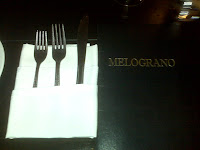
Porcini was a long digression, though, and I did eventually make it to Melograno. The full story is that I had not been impressed with Melograno in the past. Everyone loved it and everyone wanted to go always, and so I gave it a lot of tries, all of which were disappointing. I will not soon forget, for example, a tough and flavorless braised veal with waxy, congealed polenta. But, I was willing to forgive, even if I wasn’t going to forget.
I wasn’t able to reschedule with the original dinner date, but in true Amni fashion, was able to finagle a last-minute double date with a couple that previously double-dated with us at Melograno. The new space is much larger, which is great because 1) you’re not elbow to elbow with strangers (some people like that, but it’s more a logistical thing with me—I hate having to squeeze between tables to get to seats, making my bum very vulnerable to knocking over bottles of wine or glasses of water), 2) there’s now room for three or four larger, round tables that seat around six people (I love round tables), and 3) from an OPIM standpoint, increased capacity generally means decreased wait-times. All good. Now for the bad: I guess that when one has to decorate a larger space, it’s harder to make things feel intimate. The rustic feel of the former space was translated to white-washed wood panel wainscoting, and walls painted in a warm sunny color. And despite the shelves that held terra cotta pots of mums and other little “rustic” trinkets, I still felt like something was missing because there was too much blank space.
The new space must have had some sort of effect on me, though. I started with a special roasted beet salad with pears drizzled in honey, walnuts, aged goat cheese, arugula and a delicate lemon vinaigrette. The table agreed that it must be THE perfect salad, with flavors and textures so perfectly in harmony. For my entrée, I had the special again—veal ravioli. It was delightful, though I generally prefer my pasta to be cooked a little longer. The other couple both had fish—the bronzino and the orata—and their plates were completely clean by time our table was bused. My husband can’t refuse a seafood pasta, and so got the pappardelle with shrimp and scallops. I definitely used wife privileges to try it myself and it was delicious with the shrimp and scallops perfectly cooked in the tomato-based sauce. He, having become the connoisseur of seafood pastas, said that he has had better, but the plate that didn’t need to be washed was indicative of more-than-decent.
The thing that makes Melograno so great, though, is that Wharton loves it and shows up in droves. Maybe it’s the upscale, MBA version of 90210’s Peach Pit. In the old space, I was guaranteed to see a Wharton MBA there, even when I was just passing by. This past Wednesday night in the new space was not an exception. The WGA was having one of its small-group dinners at a round table and a clan of Wharton Japanese women dined at the round table right next to it. I went to second-year drinks afterwards only to talk to someone else who had also just been there. I love that, because “Sometimes you want to go where everybody knows your name, and they’re always glad you came.”
Next Time: Home Brew Part I – Amni embarks upon the world of home brew. Will her homemade nut brown compare to the Newcastle she loves so much?
Sunday, October 19, 2008
The Wharton Palate: Girls' Night In
I was invited to a girls’ night potluck in honor of a WG’09’s birthday last week. I signed up to bring cupcakes and knew that since we were going to be an estrogen powerhouse, it had to be chocolate.
I remember my first ganache more clearly than I do my first boyfriend (more an indication of my personality than his, I’m sure). Many years ago, I went to a friend’s house after school one day. My friend’s parents were avid bakers and on their way out the door (with a freshly baked strawberry rhubarb pie to bring as a hostess gift for a neighbor) they told us to eat whatever we could find. We opened the refrigerator and as if the light of heaven suddenly broke through the roof, our eyes were drawn immediately to an illuminated quarter-eaten vanilla layer cake swathed in a perfectly smooth, matte-finished, thick, creamy, decadent chocolate ganache blanket. I’ve been in love ever since.
I usually keep some ganache in the fridge just in case an impromptu fondue fest arises (you never know). This stash would save me since I didn’t have time to make frosting from scratch. And you know me—I wasn’t about to buy the premade stuff. I had a cupcake recipe, too. I found a very quick and easy recipe on allrecipes.com after I messed up a Gourmet magazine version that required whipped egg whites and yielded chocolate rocks.
After a round of golf, I ran home, threw together the cake ingredients, loaded up the muffin pan, threw them in the oven for 20 minutes, cleaned my golf clubs and put them away, popped out the finished cupcakes onto a cooling rack, took a shower, put on some clothes and an apron, met with my presentation partner for 30 minutes, kicked out my presentation partner, and then started re-melting the ganache over a double boiler, constantly stirring to make sure it did not burn. I took it off the heat when the chocolate was glossy and fully melted, picked up a cooled cupcake carefully by its base and placed it, top first, into the pot, slowly and deliberately rolling the top in the chocolate to ensure even frosting.
He came back from his own round of golf as I was leaving for the birthday potluck. I doubled the recipe so I could give some to another friend whose birthday was the next day and so that we could have some at home. I instructed him to try one after dinner.
I walked the block-and-a-half to the Dorchester with my platter loosely covered with tin foil. An older couple walking in the same direction started conversation with me, mainly jokes about how they wanted a cupcake. I politely smiled to hide my annoyance and got to my destination safely, with the full dozen cupcakes intact.
I was the last to arrive and we dove immediately into the dinner, which was a motley mix of various Chinese-style vegetable dishes, fried chicken, rosemary chicken, and tomato-pecorino flat bread. Despite the inconsistency of cuisine origin, everything was wonderful and exhibited the unique personalities of the participants. The wine poured freely, as did the catty smack-talking and laughter. We complained and encouraged each other as we prepared for FIP interviews. We talked about relationships, wedding planning, and being single. Finally, we were sated and ready for dessert. Candles were lit, a happy birthday song was sung, and a birthday wish was made.
This was the moment of truth. Full disclosure: I had lost count of the cups of sugar while making the cupcakes. The recipe required three, but there was a chance I stopped at only two. I didn’t do that well in LGST 652 (Ethics) and therefore didn’t find a need to tell anyone until just now.
I definitely forgot that cup of sugar. The cupcake part was dry and tasted kind of like a Tootsie Roll (god, I hate Tootsie Rolls), like fake chocolate. Thank goodness for the ganache, which masked the off-ness of the cake and stole the show. I even saw an abandoned cupcake bottom, which had mercilessly been beheaded for its chocolate hat. Poor cupcake. Overall, they were a hit. No one stopped at one. One of us had two and most of us shared additional halves. The birthday girl took one home for later.
Sometime in the middle of the potluck, I got a BlackBerry message from my husband: “Ate a cupcake. Looks like Mr. Hershey pooped all over my face.” That was the best compliment this girl could receive. I’m still beaming.
Next Time: Melograno, a favorite amongst Whartonites, has moved, but is the food still the same? I revisit the intimate Italian with the WG’09 who took me there for my first Melograno experience.
Recipe: Adrienne's Family Chocolate Ganache
Monday, October 13, 2008
The Wharton Palate: Double Dates (at Parc Brasserie)
Three months is not actually a long time to be away from Philadelphia (as evinced by the still-vacant former-Wawa space below the Dorchester that I’m hoping will turn into some sort of Wharton Peach Pit), but there were some dramatic changes that occurred. There was, of course, the closing of Melograno on 22nd and Spruce. (Fear not. I too was scared and immediately jumped onto some of Philly’s robust food blogs to find that it will reopen – grapevine rumors tell me it’s open already – at a new and near location: 2010 Sansom Street). Riverwest residents have been excitedly talking about the new pizzeria and burrito place that opened up nearby. Then, there’s Parc. On my way to a triple double date (yeah, that’s right) at La Viola, and already in pain after only two blocks of walking in four-inch Louboutins, I forgot temporarily about how I wanted to saw off my feet when I saw the warm, glowing lights of this new French style brasserie on the ground floor of the Parc Rittenhouse on 18th and Locust. Apparently, Stephen Starr was busy at work on his continued plan for world conquest while we were away.I was mesmerized. Waiters, carrying trays of cocktails and wearing long, white aprons, deftly maneuvered between outdoor tables and foot traffic. Lots of well dressed people (a welcome sight after experiencing a dire fashion drought in San Francisco this summer) sat sipping champagne and feasting on iced tiers of raw oysters with delicate spoonfuls of mignonette sauce. How indulgent. For a city that does the beer culture so well, this was a glaring anomaly. If I hadn’t walked into a fire hydrant I might have forgotten about La Viola.
I got a call (actually, an Outlook meeting request) the next day from a close friend in my cohort who suggested a double date on Friday. An opentable.com reservation was made in about 2 minutes and I accepted the meeting request with an updated location: Parc.
As I waited for the week to pass, I often thought of some very fine dinners at Balthazar in New York City. Balthazar and Parc emulate well in appearance the fine brasseries of Paris. Balthazar offered, in addition to the warm, lively décor, amazing food. I will never forget, for example, their frisée salad with crisp-on-the-outside-and-chewy-on-the-inside bits of lardons, tossed in a delicate vinaigrette and topped with a perfectly poached egg. Balthazar’s cassoulet, though a failure compared to my French mother in law’s, was a bowl of comfort and symbolized warm, boozy dinners on cold winter nights. Would Parc meet these standards so engrained on my psyche?

This was a fantastic opportunity to really get to know another couple, both members of which are WG ‘09s. One is a venture capital guru and the other an energy king, but both are true foodies, reverent and humble before cuisine. The truly great thing about going to dinner with such experts is that they write the reviews for you. Here’s an excerpt from one of our debrief emails (Oh, Wharton! How you have influenced me!):
“Parc is a pure Stephen Starr restaurant in all ways good and bad. The good includes an amazing location, the constant buzz of the crowd, service that was polite if not precise, and a menu that was evenly executed and diverse. The bad is perhaps more subtle, but includes food that at all times relies on being rich and decadent in order to be "good", which means that dishes can be overwhelmed by one or two dominant flavors, and sometimes are presented a bit blandly in terms of color and texture… All in all, worth a visit, but for pure foodies, as with most Stephen Starr places, you can probably find better fare, albeit, with less glamour.”
Between the four of us, we tried the petit plateau of iced raw oysters, clams, mussels, steamed shrimp, and crab. All were fine, except the clams could have been fresher (there’s really nothing worse than not-fresh clams). The escargot was not served in the usual plate with eight concave puddles for each snail and butter, but in an iron pot. The genius of this presentation was that there was plenty o f garlicky butter to coat infinite slices of baguette, which, by the way, was excellent. Perhaps some of the best baguette found outside of France. There was no cassoulet on the menu, and I settled with the beef bourguignon. Others had the branzino, lamb, and daily special bouillabaisse. And just as my dinner partner wrote, everything was lovely, but nothing was mind-blowingly spectacular. My bourguignon was flavorful, but a bit dry. My husband’s bouillabaisse had an interesting fennel-flavored twist to the broth, but we both agreed that we’ve had better.
Despite my string of mediocre comments, really, Parc was worth it. We had a very sympathetic, knowledgeable server (French-Canadian… close enough). The crowd was diverse in age and high on making the evening at Parc an oxymoronic pedestrian indulgence. In sum, we had a blast.
The wonderful thing about intimate dinners is that one gets to really know the players. And if at Wharton one of our main goals is to form relationships, to make the ties that will eventually help us in our professional endeavors, to network, then truly getting to know one another over wine and food is really the best way. Given the plentiful drinks, reasonable food, and small tables, Parc delivered.
Parc: 227 S. 18th Street, at Locust Street. (215) 545-2262.
Next Time: The Wharton Palette participates in the ultimate female past-time. No, not a pillow fight in lingerie at a sleep over. Rather, a group of us get together to celebrate a birthday by having a very boozy potluck dinner.
Sunday, September 14, 2008
The Wharton Palate: Dining In
Syllabus. I’ve always been obsessed with food, but this summer, I was particularly immersed; my internship was at a soup kitchen in San Francisco (required reading: Michael Pollan’s 2006 Omnivore’s Dilemma), where I was surrounded by the Slow Food Movement (http://www.slowfood.com/) and slapped upside the head by the muse. I gave myself an assignment, requiring much research and several final presentations: make pasta sauce from scratch. Included in my syllabus were the following ground rules: 1) whenever possible, use only ingredients found in nature (i.e. no canned tomatoes!), 2) whenever possible, use organic/free-range ingredients, and 3) other Wharton grad students must be involved.
This is how I came to be carrying 7.5 lbs of organic, vine ripened tomatoes, 1 lb of bones from free-range chickens, a 3.5-lb whole, organic, free-range chicken, a bottle of pinot grigio, and other sundry items, through all of Hurricane Hanna’s vicious glory last weekend.
Midterm Exam. The roast chicken dinner was my problem set. I decided that inviting only one WG ’09 (my husband) to pontificate on the chicken-y-ness of free-range chicken wouldn’t be enough and therefore emailed a certain WGA President to come over. Two bottles of wine later and with absolutely no leftovers making its way back to my refrigerator, the three of us found ourselves content and heading over to Ten Stone to watch fights break out and to ask even more people about what they did this summer. (OMG, really?! That’s so cool! Are you going back? Are you going to recruit again? Blah, blah…)
Midterm Presentation. Did the free-range chicken taste more like chicken? Though tasty, the overwhelming consensus was no, not really. Was it juicier? Yes, even the white meat portions were more tender than that of my prior roast chickens... but, I guess that without a control chicken, we’ll never really know. Was the 100% premium and trip to Reading Terminal Market on a crowded Saturday afternoon in the rain worth it? No.
The chicken, however, was only the midterm in an iterative course. All the leftover bones, plus carrots, celery, and the pound of extra bones that I picked up, were drunkenly thrown into a slow cooker when I got back from Ten Stone and set on low heat for 8 hours. When I woke up with a mild hangover, voila, I had chicken stock, which was part of my final assignment.
Final Exam. I haven’t purchased canned pasta sauce in over two years. No Ragu. No Prego. No Classico, Buitoni, or even Newman’s Own. I’ve been making my own in the slow cooker using a 1:1 ratio of canned whole San Marzano tomatoes and canned tomato paste. To recreate the whole tomatoes, I stewed peeled tomatoes in chicken stock and white wine (extra credit for alcoholic ingredients!). For the paste, I saw Ina Garten roast plum tomato halves in the oven with just a sprinkling of kosher salt, pepper, and olive oil—which I did, only for a lot longer, at lower temperature, and then pulverized into a paste in the food processor.
Final Presentation. I accidentally threw in too much hot pepper flakes into the sauce as it was reducing (yes, I was again a bit tipsy after “catching up” with a fellow WGA ’09 Community Service DVP), so I guess it became an arrabbiata. The final presentation dinner was penne con melanzane (penne with eggplant… Wharton Italians, please do not kill me for making the American bastard son of this dish). My husband was at a corporate sell dinner (Really? Already?), so I had another WG’09 come over in between Fashion Show and BizWorld meetings.
Seven pounds of tomatoes, purchased for about $15, reduced to something like one normal, 25-oz jar of pasta sauce, which one can find for around $2.50 in a grocery store ($5 for an organic version). We agreed that, though the sauce tasted better than jarred versions, $20 for raw materials plus about 8 hours of direct labor were not a cash flow positive investment. No economies realized, that’s for sure.
Debrief & Take-Aways. Though networks were built through meaningful conversations over yummy, though impractically made meals, I will go back to making pasta sauce with canned tomatoes. I can, however, say that I tried and if ever in a consulting interview someone asks me how many tomatoes one needs to make a 25-oz jar of pasta sauce, I will know. And so will you. You’re welcome.
Next Time: The Wharton Palette goes on a double date to the new Stephen Starr mega-bistro, Parc, on 18th and Locust Streets. Will this Balthazar wannabe hold a fork to Keith McNally’s 11-year, New York City hotspot?
Recipe: Simple Roasted Rosemary Lemon Chicken, with Sauce
1 3.5-lbs Whole roasting chicken (take out but keep whatever offal is included)
2 Lemons (1 cut into eighths, 1 juiced)
1 Medium yellow onion, unpeeled and cut into eighths
6 stalks Fresh rosemary
4 cloves Garlic (3 whole w/ peel on, one peeled and minced)
2 Tbs Butter, unsalted
1 Tbs Kosher salt
1 Tbs Fresh ground pepper
4 Tbs Olive oil
For Sauce:
1 cup Chicken stock
1/2 cup White wine
2 Tbs Lemon juice
Kosher salt
Pepper
Directions:
Pre-heat oven to 425ºF.
Chop finely the leaves of 4 stalks of rosemary and place in small bowl. Mince one garlic clove and add to rosemary bowl. Add salt, pepper, olive oil, and juice of one lemon. Mix with spoon. Set aside. (The beauty of roast chicken is that you can use whatever herbs and spices you might have laying around–parsley, tarragon, dill, oregano–and if you do not have fresh herbs, try and get some but if you absolutely cannot, use smaller amounts of dried herbs... whatever you have on hand!)
Place removed offal (neck, livers, etc.) at the bottom of the roasting pan.
Rinse chicken (inside and out) and pat dry with tons of paper towels. Stuff inside of chicken with cut lemon, onion, whole garlic cloves, and two stalks of rosemary. Carefully creep fingers in between the skin and the breast. Place one tablespoon of butter under the skin over each breast. Rub the outside of the entire chicken with the rosemary mixture. Tie legs together with kitchen string (I often get creative because I never have kitchen string for some reason) and place chicken on roasting rack in roasting pan.
Place chicken in oven for 20 minutes, then reduce heat to 375ºF. Roast for 1.5 hours. Baste chicken every 30 minutes with the juices that gather at the bottom of the pan – the skin will become golden brown and crispy… yum! I don’t have a meat thermometer, but really should invest in one since cutting into the chicken to look for any pink just ends up releasing the juices into the pan instead of keeping it in the meat! But, if you don’t have a thermometer, cut into the thigh—if clear juices run out (not pink), then you’re done! Remove the chicken from the oven and set aside for at least 10 minutes to let juices settle back into the meat.
As the chicken rests, remove and set aside roasted offal for later use in stock. Tilt pan to gather juices in one corner and with a spoon, skim off and discard the clear fat from the top of the puddle. Place roasting pan over stove burner and turn on heat to medium. Add wine and with wooden spoon, scrape bottom and sides of pan to loosen all the baked in goodness. Once wine has reduced and brown bits have been loosened, add chicken stock and lemon juice and reduce to just ½ of original volume. Remove from heat and serve with carved chicken. towels.
Saturday, September 13, 2008
Recipe: Easy Slow Cooker Chicken Stock
1 gal. Water
1 Bones and offal (roasted) of whole roasted chicken
1 lb. Chicken bones (ask your butcher!)
2 Celery Stalks
2 Carrots
2 Medium yellow onion, unpeeled and quartered
2 cloves Garlic (3 whole w/ peel on, one peeled and minced)
1 Tbs Kosher salt
1 Tbs Fresh ground pepper
Directions:
Add all ingredients (I add a stalk or two of rosemary or a bunch of fresh parsley if I have some around) into a slow cooker and set to low temperature for 6-8 hours. (If you do not have a slow cooker, you can use a stock pot or Dutch oven, but be careful to set the stove burner to a very low simmer for only about 3 hours.)
Turn off heat and strain the liquid of the bones and vegetables, which can be discarded. Take the saved liquid and place in refrigerator overnight. The cooled liquid should have a solidified layer of fat at the top. Skim off and discard the fat. Remaining stock can be kept in the refrigerator for 3 days, or frozen and kept for much longer!
Use stock for soups, sauces, rice, cous cous…
Tuesday, September 9, 2008
Recipe: The Most Time-Consuming Pasta Sauce. Ever.
24 Very, VERY ripe medium sized tomatoes
2 cups Chicken stock
1 cup Dry, white wine
2 cloves Garlic, minced
8 leaves Fresh basil
4 leaves Bay leaves
1 Tbs Dried oregano
2 Tbs Sugar
Red pepper flakes
Kosher salt
Fresh ground pepper
Olive oil
Directions:
Pre-heat oven to 300ºF. Slice 10 of the tomatoes into ¾ inch rounds. With fingers, scrape out and reserve seeds and juice of tomatoes. Place tomato slices on greased baking sheet, sprinkle slices with kosher salt, fresh ground pepper, and drizzles of olive oil. Bake tomatoes for one hour, until tomatoes look a bit dry and shriveled.
While tomatoes are baking, take remaining 14 tomatoes and make a small cross cut at the bottoms of each of them. Scald in boiling water for 30 seconds and immediately shock in a bowl of iced water. Peel tomatoes and place, with reserved tomato juice/seeds, in a large pan. Add stock and white wine, adding more of each if necessary to cover tomatoes. Bring pot to boil, then reduce to simmer. Add bay leaves, basil, oregano, sugar, pinch of salt and generous pinch of pepper. Simmer until only ¼ of liquids remain (about 45 minutes).
After baked tomatoes are done, place in food processor and pulverize into a thick paste. Add this paste to the boiling pot of peeled tomatoes, which should start to easily break apart when crushed with a wooden spoon.
Continue to stir and break up tomatoes as liquids reduce until sauce becomes desired consistency. Also continue to taste and adjust seasoning during simmering. Don’t be afraid of sugar and salt, which often brings out the great tomato flavors! Once sauce reaches desired consistency, serve immediately, work into a lasagna, or cool and freeze for future meals!